Category Archives: Student Education

Fashion & Ethics: Hadley Freeman, Wayne Hemmingway & Safia Minney

Fashion Matters

Title: Fashion & Ethics: Hadley Freeman, Wayne Hemmingway & Safia Minney
Location: V&A, London
Link out: Click here
Description:

“Join Observer journalist Lucy Siegle, Professor Reina Lewis and guests to discuss the impact of ethics on fashion.” (V&A)

Centre for Sustainable Fashion:
“LCF Professor Reina Lewis and guest Lucy Siegle and Christian Kemp-Griffin disucss the impact of ethics on matters of style. Is green still the new black or will the credit crunch make cheap clothes a renewed priority for hard-pressed consumers? As fur makes a return to some catwalks, we consider whether new smart fabrics will redefine luxury, and explore how technological advances in the design and delivery of fashion open up the bespoke experience to new consumers. Also, the politics of pleasure.”

To register, click here.
Start Time: 7:00pm
Date: 2009-10-27

Source: Centre for Sustainable Fashion and V&A

Centre for Sustainable Fashion Competition: Fashioning the Future

Image via Centre for Sustainable Fashion, London College of Fashion

Image via Centre for Sustainable Fashion, London College of Fashion

“Fashioning the Future brings together a global community of creative thinkers and doers, designers, innovators and entrepreneurs ready to offer the fashion industry opportunities for the future.

Founded in 2008, Fashioning the Future has been developed to include a wider range of disciplines, now with seven separate awards, celebrating and promoting a generation of emerging talent for the fashion industry of the future.

The possibilities for our future lie in the ingenuity of our creative minds. The competition is the leading international platform for celebrating innovation in sustainable fashion design, development and communication and we hope students and recent graduates from across the global fashion industry are inspired and excited to contribute through their work.

The underlying issue of consumption, the theme for the 2008 awards, will continue to be a crucial issue to fashion and its sustainability. Aligned to this, the theme for 2009 is Water, and there is a specific cross-discipline award focusing on this.”

Closing date 7 October 2009 at 1600hrs GMT.

Source: Centre for Sustainable Fashion, London College of Fashion

FEI: Call for Academic/Research Papers and Student Projects

FEI Image

Fashioning an Ethical Industry International Conference: Fast Forward will take place on the 2nd and 3rd March 2010. It will bring together educators, industry experts, academics and selected students to explore how fashion can be taught to inspire responsibility for the rights of the workers making our clothes.

Alongside our set programme of speakers with expertise in the industry, we will provide the opportunity for the presentation of academic research papers and for students to present their project or dissertation work at the conference.  

Academic/Research Papers Papers are welcomed that address the following or related themes:

  • Social responsibility in the garment industry (with an emphasis on garment workers’ rights)
  • Teaching ethics within fashion education
  • Approaches to education for sustainable development relevant to fashion education

Students are invited to apply for the opportunity to showcase their project, design or dissertation work which addresses social responsibility in the garment industry. If you are a tutor please encourage your students to make a submission. 

Academics and students interested in participating in this event should submit an abstract by 30th October 2009 of 500‐700 words to liz _at_ fashioninganethicalindustry.org (replace _at_ with@). For more information on submitting papers please see the attached PDF.

Source: FEI

The Designers Accord Global Summit on Design Education & Sustainability

DA_edu_summit

NOTE: Although this event is invite only, information gathered at the summit will be compiled into a toolkit that will be made available through the Designers Accord, for free.

Title: The Designers Accord Global Summit on Design Education & Sustainability
Location: San Francisco
Link out: Click here
Description:

Overview
In San Francisco, on October 23 and 24, 2009, the Designers Accord will convene 100 individuals (an invited group of undergrad and graduate design education faculty and administrators, thought-leaders, experts, and select student ambassadors) for two days of highly participatory discussion, planning, and action around the topic of sustainability and design education.

The Summit is structured so that we address the critical topics in design education and sustainability, and create a toolkit for people to use right away. The formula:

100 educators, administrators, and thought-leaders
48 hours in San Francisco
6 inspirational – 30 minute speeches
8 breakout worksessions of highly participatory small group brainstorming
1 open exhibition of work, projects, programs
Time to talk, think, learn, problem-solve, and imagine possibilities

Goal
We will draw on the experience and knowledge of our global community to tackle the critical issue of sustainability, consider how best to prepare our educational community to make real change, and imagine what’s next in design education.

Our goal is to have a lively and rich discussion during the summit, and then publish the best practices and recommendations for integrating sustainability into design and media programs to the public.”

Start Date: 2009-10-23
End Date: 2009-10-24


Source: The Designers Accord

new teaching resources just in time for the fall semester

If you are thinking about incorporating responsible design into your curricula this upcoming fall semester here are a few resources to get you started.

Nathan Shedroff, author of the book, Design is the Problem:  has recently published free curricula under Creative Commons license.

This is a series of free syllabi and teaching materials to help instructors teach students key topics for the future. These courses are studio courses, meant to teach students by making and doing, instead of merely reading and regurgitating. These syllabi are ready-to-use but can easily be customized for different situations. They are primarily created for design and business programs at the graduate and undergraduate level but can be adopted for teaching to most any audience at most any level. (Shedroff, Thoughts)

Design is the Problem: A course in sustainable design 1.0

Experience Studio: Exploring the full dimensions of experience design 1.0

Market Insight Studio: Research for more meaningful offerings 1.0

The curriculum contains syllabi and presentations and even comes complete with evaluation criteria for the Final Project Presentation (coming soon). Each studio course is easily downloadable, as Shedroff has, not surprisingly, made access to the information extremely user-friendly. Shedroff has truly delivered a fantastic resource in these studio courses.

Another must have for fashion design educators is Teaching Sustainable Fashion: An Educators Handbook, so make sure to add these articles to your course syllabus. We have highlighted the importance of this resource before, but with the new fall semester approaching, it is definitely worth another look. Chapters are broken up into different categories: Design, Business, Marketing, Interactive Activities, Cross-Curricular, and Pedagogy and Institutional Approaches.

You can download the entire handbook or each chapter separately on the Fashioning an Ethical Industry website, here.

Here is a look at the article titles and authors in the chapter on design:

On teaching empathy, Sue Thomas

Slow fashion, Kate Fletcher

Designing slow fashion, Kate Fletcher

The elephant in the room: Contextualising the ethical within fashion excellence, Mo Tomaney

Collaborating with fair trade producers: Design and trends, Tony Hicks

Customized denim project with further education students studying BTEC National Diploma Art & Design (Fashion & Clothing), Maria Skoyles

Clothing care calculator: An interactive tool to evaluate environmental impact, Katie Dombek-Keith and Suzanne Loker

Style showdown , Sara B. Marcketti

Introducing the cotton supply chain and sustainability, Südwind Agentur

Ideas for design briefs, Fashioning an Ethical Industry and Abbie Price
Design Revolution

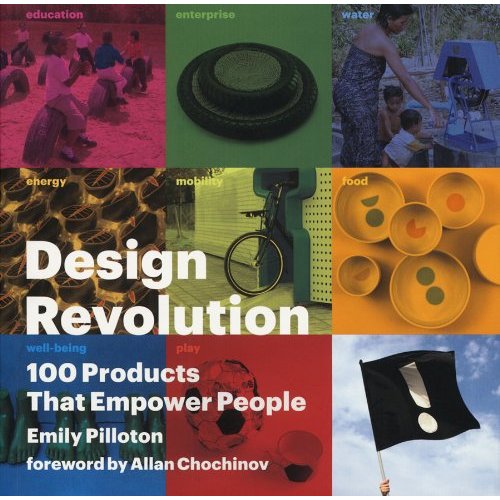
Last, but not least, we posted earlier re: Emily Pilloton’s new book, Design Revolution: 100 Products that Empower People, and are happy report that it is now available for purchase. Here is what Valerie Casey, Global Practice Head, IDEO; founder, The Designers Accord, had to say about Pilloton, and the book:

 
“Pilloton is a force of nature and Design Revolution is the perfect
storm of inspiration, optimism, and ingenuity. This book should be
on every designer’s shelf — no, in his or her hands.”

Just in time for the fall semester!


Source: Core77, Nathan Shedroff, FEI, and Project H
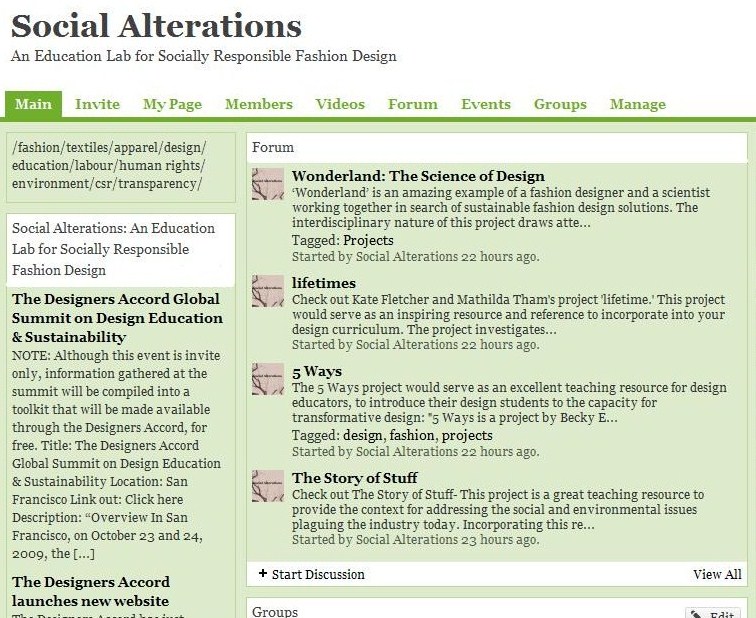
Social Alterations is now on Ning!

smallSocial_Alter


You can use this space to share and upload curricula ideas, lesson plans, visual aids, research and projects, or to just discuss the current happenings in the industry with respect to social issues and environmental concerns, as well as the latest trends in socially responsible design.


screenshot2


“See” you in the Forum! Oh…and don’t forget to pick up your Social Alterations Badge!


Visit Social Alterations

FIBERcast 3: Environmental Sustainability in the Apparel Industry

fiberlogo

The 3rd installment of FIBERcast went live on July 31, 2009. This episodes theme? Environmental Sustainability in the Apparel Industry. Thought I might offer some notes that stood out from the 1st half of the broadcast.

Moderator: Marsha Dickson, Professor and Chairperson of the Department of Fashion and Apparel Studies, University of Delaware

Guest Speakers: Will Phillips, Manager, Environmental Strategy, Under Armour Inc., Rick Horwitch, Vice President, Solutions Business Development and Marketing, for Bureau Veritas – Consumer Products Services, Dr. Suzanne Loker, Professor, Cornell University, Huantian Cao, Associate Professor, University of Delaware

The talk started off with Professor Huantian Cao breaking down the UDSAI Policy Guide (which mainly focuses on the environment).

Dr. Suzanne Loker defined sustainability broadly as “economic development, the environment, the impacts of people in their consumption choices, and technological advancement.” This signifies “improving, building upon and overall achieving responsible practices that are mentioned over the long term. Sustainability is at the foundation of social and environmental responsibility, yet it may not be achievable. Rather, we should strive for improvement” (Loker).

Loker cites a quote taken from Yvon Chouinard, the Founder and Chairman of Patagonia, as stated in the Preface of the book Sustainable Fashion: Why Now?

“To be sustainable means that you would take-out of a system the same amount of energy as put in, with no pollution or waste. A sustainable process is one you can do forever without exhausting resources or fouling the environment […] There has never yet been, nor is there now a sustainable business or sustainable fashion on this planet, and no one should ever pretend in setting out for a place that you’ve actually gotten there.”

Sustainability is a continuous goal, one that can never be achieved. Rather, it is something to strive towards. In this way, it needs to be larger than individual businesses.

Huantian Cao covered 3 equally important pillars of sustainability:

  • Economic
  • Environmental
  • Social

Speaking in detail on what companies can do today to get started on their environmental sustainability in terms of scope of business activities, both Loker and Rick Horwitch, Vice President, Solutions Business Development and Marketing, for Bureau Veritas – Consumer Products Services stressed their belief that every member of the supply chain has a contributing role in decreasing the environmental impact through input and matching production to consumption.

To get started immediately, Horwitch suggests companies tackle the issues through design, production, supply chain, and corporate perspective:  

Design perspective

  • AFA: Restrictive Substance List (RSL) (all globally encompassing it covers the apparel and textile and footwear industry) get rid of the bad substances in your products.
  • Packaging: reduce ratios. Look for biodegradable content, energy efficient.

Production

  • Look at energy efficiency. Horwitch recommends companies check out The Footprint Chronicles over on the Patagonia site.

Supply chain

  • Look at transportation
  • Look at social compliance. Social compliance is critical. Ethical sourcing is critical to a sustainable supply chain.

Corporate perspective

  • Be a good citizen.
  • Communicate that the issues are important to you.
  • Do large scale changes, but do not ignore the small changes, such as changing the light bulbs.

What is the business case to engage in this shift?

Horwitch maintains that while the front end may be more expensive,  “sustainability is about the triple bottom line and a for profit solution. Sustainable process is an efficient process.”

Triple bottom line? Remember those three pillars Huantian Cao mentioned:

  • Economic
  • Environmental
  • Social

For more information, you can listen in on this FIBERcast, as well as previous broadcasts, here.

Resources to walk away with:

University of Delaware’s Sustainable Apparel Initiative

Sustainable Fashion: Why Now?

Restricted Substance List (RSL)

Patagonia: The Footprint Chronicles

FIBERcast

Source: FIBERcast

Social Alterations: Forum

How can education foster sustainable change toward socially responsible fashion and apparel design and manufacturing practices?

Social Alterations Forum

Social Alterations hopes to foster socially responsible fashion design education through aggregating relevant material that will inspire fashion/textile and apparel instructors, researchers, designers and design enthusiasts to get on board with thinking about consequence in the industry.

Sign up to the Social Alterations Forum if you’re interested in sharing and contributing ideas on curriculum, research, projects, materials, design, etc. with this community.

Don’t Mess with Design Thinking…..?

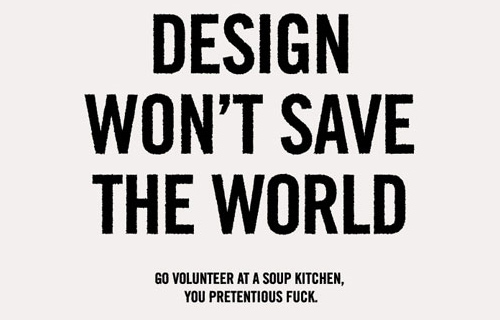
Stop Saving the World

This week, Michael Roller challenged young designers to reconsider saving the world.

Stop Saving the World

…Unless you actually are. Designers have identified that their skills can help people beyond the mass markets of the first world, but we’re far from making a big impact on our own. The truth is, some designers like talking about making a difference more than they like actually doing it. Raising awareness is only a small first step towards fixing one of the world’s many problems. If you really want to make a difference, think about volunteering at a soup kitchen…or moving to India.

Ramsey Ford is an industrial designer who recently took on this challenge by moving to India and starting the non-profit Design Impact. “Last year, I attended the ‘Design for a Better World’ conference at RISD. What struck me most about the conference was that the common thread was not design, but entrepreneurship. The mantra for the weekend seemed to be, ‘shut up and do it’.” Ramsey plans to make a real difference by gaining empathy for India’s true design needs. Admittedly, this is pretty bold, but what have you done lately to design a better future?

Rolland is merely advising recent graduates to, in a sense, shut-up and get-started already. In the context of ‘self-promotion’, selling your personal brand as ‘sustainable’ or ‘green’ (or whatever buzz word you happen to run with) is really nothing above insult if you are not in fact taking this challenge seriously.

Matthew E. May wrote “Design Thinking 101” earlier this month and cited the Wikipedia definition of the process (taken from a 1969 book by Herbert Simon called The Sciences of the Artificial):  

Design thinking is a process for practical, creative resolution of problems or issues that looks for an improved future result. It is the essential ability to combine empathy, creativity and rationality to meet user needs and drive business success. Unlike analytical thinking, design thinking is a creative process based around the “building up” of ideas.

Pergaps the real challenge is for designers to stay away from Design Thinking as a brand image alone, and move creatively toward incorporating the process into every aspect of their work.

Source: Core 77, Open Forum

FEI Staff Training and Student Workshops

FEI Staff Training and Student Workshops

Ethics have a high profile in the fashion industry today. Are you equipped, as a tutor or student, with the knowledge and skills to engage with these issues?

Fashioning an Ethical Industry (FEI) runs staff training and student workshops at schools, colleges and universities on themes related to working conditions in garment manufacture. Through our training events we encourage staff and students to critically examine different perspectives on workers’ rights and initiatives to improve conditions.
FEI training combines our extensive knowledge with a participatory educational approach, building on participants’ existing knowledge and experience and using a range of activities and different media such as films, role-play and presentations.


More info: Fashioning an Ethical Industry

Source: FEI